
Executive Summary
- State healthcare transaction notification laws have become a significant deal execution consideration, with an increasing number of states requiring advance notice to, or approval from, state regulators before certain healthcare transactions may close.
- These laws often extend beyond traditional provider acquisitions and may apply to transactions involving Management Services Organizations (MSOs), physician practice management structures, digital health and telehealth companies, risk-bearing organizations, value-based care platforms, and other healthcare-adjacent businesses, including businesses backed by private equity or venture capital.
- Filing requirements, review timelines, and substantive regulatory scrutiny vary significantly by state. In some jurisdictions, parties may be required to submit notice materials as much as 180 days before closing, potentially impacting transaction timelines, financing arrangements, and deal certainty.
- Early assessment of state healthcare transaction requirements is critical. Identifying potential filing obligations at the outset of a transaction may provide opportunities to structure around certain requirements, avoid unexpected closing delays, and appropriately allocate regulatory risk in transaction documents.
- Because many state laws are relatively new and regulatory guidance remains limited, filing obligations are rarely clear. Parties should carefully evaluate potential notice requirements early in the transaction process and consider the filing approach where applicability is uncertain.
Overview
Historically, state healthcare transaction notification laws have been primarily relevant to large hospital mergers and traditional health system consolidation. More recently, however, a combination of newly enacted laws and the broader application of existing laws by relevant state agencies have extended these frameworks well beyond traditional providers.
Today, state healthcare transaction notification laws can impact transactions where the engaged parties and their advisors are not accustomed to building such notices in their deal workstreams (such as MSOs, digital health platforms, private equity, and risk-bearing entities). These healthcare-adjacent businesses, which historically may not have been subject to healthcare transaction review laws, may increasingly face filing obligations, extended review timelines, public scrutiny, or substantive regulator engagement in connection with acquisitions, formations of MSOs, investments, restructurings, affiliations, and platform transactions.
For deal teams, these laws now function as a healthcare-specific Hart-Scott-Rodino (HSR) regime, but with materially less uniformity, predictability, and precedent.
Importantly, state healthcare transaction notification laws are highly inconsistent across jurisdictions. There is significant variation with respect to the included entities, revenue and transaction thresholds, filing timing, review periods, substantive standards, confidentiality, and enforcement authority. In many states, the statutory language remains ambiguous, and agency guidance and history are limited.
As a result, transaction parties often underestimate both the potential applicability of these laws and the extent to which they can affect transaction timing, signing strategy, purchase agreement negotiations, financing timelines, public announcement and disclosure of the deal, sharing of company information, and transaction costs.
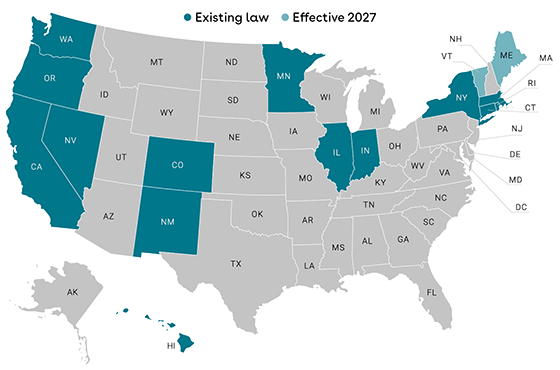
The following states currently have state healthcare transaction notice laws:
|
State |
State |
|
Vermont (effective March 1, 2027) |
|
|
Maine (effective January 1, 2027) |
Recent State Examples
California’s and Vermont’s evolving healthcare transaction frameworks are particularly illustrative of this trend.
California
As discussed in our prior alert, “California MSO Transaction Notification Requirements Begin January 1, 2026,” California’s AB 1415 significantly expands the scope of entities and transactions potentially subject to review by the Office of Health Care Affordability (OHCA).
Healthcare transactions involving physician platforms and PE- and VC-backed healthcare structures are typically executed at the MSO level, meaning that the buyer acquired the MSO rather than the affiliated professional corporation (PC), which remained under licensed-physician ownership to satisfy the corporate practice of medicine prohibition. Before AB 1415, California’s healthcare transaction review law focused on transactions with licensed providers and traditional healthcare entities and, therefore, did not capture the healthcare transactions involving PE- and VC-backed healthcare structures executed at the MSO level. AB 1415 substantially narrows that perceived gap by expressly extending notice obligations beyond traditional providers to newly defined “noticing entities,” including private equity groups, hedge funds, MSOs, newly formed acquisition vehicles, and entities that own, operate, or control providers.1
Vermont
Historically, Vermont’s healthcare transaction notification requirements have applied only to hospitals. Under 18 V.S.A. § 9405c, a hospital in Vermont that acquires a medical practice must notify the Attorney General at least 90 days prior to the transaction’s effective date.
However, on June 15, 2026, the governor of Vermont signed H.583 into law. Beginning March 1, 2027, H.583 requires healthcare facilities and MSOs to notify the Green Mountain Care Board (GMCB) when:
- a private equity group or hedge fund takes on an ownership or investment interest in the healthcare facility or MSO that had not previously been reported to the GMCB; or
- there is a modification to a private equity group’s or hedge fund’s existing ownership or investment interest in the healthcare facility or MSO.
Notably, entities that deliver healthcare services in Vermont but exclusively through telehealth are exempt from the new notification requirement.
Key Areas of Ambiguity That Can Create Deal Risk
Inconsistent Definitions and Scope
One of the most significant challenges in assessing the applicability and scope of state healthcare transaction notification laws is that the laws vary materially from state to state in how they define the entities subject to notice. Some states limit their definition of “health care entity” to licensed healthcare providers, while others expand the scope well beyond the traditional provider framework to capture management and investment structures.
For example:
- Massachusetts' material change notice regime extends to certain MSOs that “represent providers in contracting with carriers,”2and Washington’s law defines “provider organizations” broadly to include entities involved in the business of healthcare delivery or management that contract with carriers or third-party administrators.3
- Minnesota’s framework focuses in part on whether an entity exercises “control”4over a provider group practice, creating potential scrutiny of management structures and affiliated entities even where the transaction does not involve a traditional hospital system.
- Indiana’s healthcare transaction review law expressly includes certain private equity partnerships within the definition of “healthcare entity,” even where the private equity partnership is located outside Indiana.5
Compounding this challenge, states have issued varying levels of statutory and regulatory guidance on how key terms should be interpreted. Certain states define key concepts such as “control,” “provider organization,” or “contracting affiliation,” while others provide little or no guidance regarding the scope of covered activities. For example, Massachusetts has issued guidance clarifying that an MSO providing bargaining representation, “messenger model”6contracting, or other support for negotiating or establishing payer contracts may qualify as a “provider organization” even if the MSO is not itself a signatory to the payer agreement. Other states provide substantially less guidance regarding whether operational, management, administrative, or contracting activities trigger filing obligations.
These ambiguities can create substantial uncertainty regarding whether a transaction triggers a filing obligation and requires thorough, fact-intensive research, and analysis to determine applicability.
Varying Revenue and Transaction Thresholds
Most state healthcare transaction notification laws contain revenue, asset, or transaction-value thresholds, but the thresholds and the methodologies for calculating them vary significantly by state. Some states focus on in-state revenue, while others look to total revenue, net patient revenue, premium revenue, or other financial metrics, each of which can require substantial diligence and complex allocation work.
For example, the Minnesota Department of Health has stated that the applicable revenue threshold under its healthcare transaction notification law is based on the healthcare entity’s overall revenue and is not limited solely to Minnesota revenue.7California, by comparison, limits its calculation to California revenue.8For national healthcare platforms, digital health companies, and MSO-PC structures operating across multiple states, confirming whether a threshold is met can require companies and finance teams to parse revenue, provider counts, ownership structures, and operational activities across numerous affiliated MSOs, PCs, management entities, and state-specific operations.
State healthcare transaction notification laws can also differ regarding which parties must satisfy the applicable thresholds. Some laws apply only when both parties to the transaction qualify as covered healthcare entities, while others may apply even if only one party is a healthcare entity. For example, Indiana’s notice requirement applies only where a “health care entity” is involved in a merger or acquisition with another “health care entity” and the parties satisfy the statutory asset threshold.9By contrast, Oregon’s framework defines a covered “transaction” to include a merger involving a “health care entity” and “another entity,” potentially reaching a broader range of counterparties.10
Timing, Closing Delays, and Expanding Regulatory Review Authority
Healthcare transaction notification laws increasingly create material timing and execution considerations that must be built into transaction planning at an early stage. Depending on the jurisdiction, notice periods can run 30, 45, 60, 90, or even 180 days before closing, and certain states can toll or extend the review period by requesting additional information or initiating more extensive substantive reviews that significantly delay consummation.
Some states, such as Indiana and New York, impose advance notice requirements alone.11Others, including California, Massachusetts, and Oregon, authorize more substantive review processes that may involve extensive information requests, public scrutiny, or additional regulatory oversight.12
California’s OHCA framework, for example, permits the agency to conduct a Cost and Market Impact Review (CMIR) through which OHCA may evaluate a transaction’s potential effects on healthcare costs, competition, market consolidation, and access to care.13A CMIR can substantially extend transaction timelines and subject the transaction to public reporting and comment.
Massachusetts similarly authorizes the Health Policy Commission to review certain material changes involving provider organizations and to conduct a CMIR evaluating potential impacts on healthcare costs, market functioning, access, and competition.14Massachusetts used this authority to scrutinize several high-profile transactions involving Steward Health Care, including a proposed physician network acquisition by a Kinderhook-backed buyer, with regulators publicly evaluating potential impacts on healthcare access, market stability, MassHealth participation, and provider consolidation.15
Oregon likewise authorizes substantive review of certain material change transactions and permits the Oregon Health Authority (OHA) to evaluate factors relating to healthcare access, cost, equity, and market impact.16 Oregon’s Health Care Market Oversight (HCMO) program further authorizes OHA to approve transactions subject to conditions. In March 2026, OHA reportedly approved private equity fund Excellere’s proposed acquisition of SuperCare, a medical equipment and pharmacy supplier, subject to conditions relating to continued Oregon Medicaid participation and limitations on retail location closures.17
Intersection with HSR and State Antitrust Filings
In addition to state healthcare transaction notification requirements, healthcare transactions may independently trigger federal HSR premerger notification obligations and, increasingly, state-level antitrust review. Deal teams should be prepared to manage both workstreams in parallel, as the timelines and substantive standards are distinct and do not necessarily align.
At the federal level, transactions meeting applicable HSR size-of-transaction and size-of-person thresholds require a premerger filing with the Federal Trade Commission and the Department of Justice Antitrust Division before closing. The mandatory 30-day HSR waiting period runs independently of any state healthcare notice period, and clearance of one does not satisfy the requirements of the other.
Several states have also enacted their own antitrust premerger notification laws that apply to all transactions, including healthcare transactions. Washington and Colorado have adopted the Uniform Premerger Notification Act (UPNA), which requires a state filing for HSR-reportable transactions where a party has its principal place of business in the state or generates annual net sales in the state equal to at least 20 percent of the applicable HSR threshold. Unlike state healthcare notice regimes, UPNA filings do not carry a waiting period or require regulatory clearance before closing.
In practice, these workstreams can intersect in ways that create additional complexity. Transactions involving multi-state healthcare businesses may require simultaneous filings across several jurisdictions, each with distinct filing requirements and waiting periods. Some states complete the review in a matter of weeks, while others may retain outside counsel and conduct extended substantive reviews that can approach the statutory maximum waiting period. Where multiple state filings must be managed on different timelines, proactive engagement with the reviewing agency—typically state attorneys general or a state health authority—can be critical. In our experience, parties that submit well-prepared advocacy materials and white papers early in the review process, and maintain an open dialogue with reviewing agencies, are better positioned to secure timely clearance and manage the overall closing timeline.
Practical Considerations for Deal Teams
Given the rapidly evolving nature of these laws, healthcare transaction review analysis should be incorporated into transaction planning as early as possible. Early healthcare regulatory diligence may help identify opportunities to structure transactions to reduce, or sometimes avoid, certain state notice or review requirements.
In our experience, the key considerations include:
- evaluating potential filing obligations early in the process, rather than after parties have already set expectations around signing and closing timelines;
- assessing whether MSOs, physician enablement structures, digital health businesses, or management entities could fall within applicable statutory definitions;
- building sufficient timing flexibility into transaction documents and financing arrangements;
- coordinating the healthcare regulatory analysis with the antitrust and corporate deal teams;
- considering whether filings may become public or prompt regulator outreach; and
- evaluating whether restructuring alternatives may mitigate filing risk or timing concerns.
Importantly, even where ultimate filing obligations are unclear, parties often must make strategic decisions regarding whether to proceed conservatively considering evolving regulatory interpretations and limited precedent.
Contact Us
Wilson Sonsini helps clients navigate the expanding patchwork of state healthcare transaction notification laws, from identifying whether a deal is subject to notice in one or more states to managing filings, regulatory review, and closing timelines. Our healthcare regulatory and antitrust attorneys work together with healthcare companies and their investors to identify reporting obligations early, structure transactions to manage regulatory and competitive exposure, and respond to substantive agency and cost and market impact review.
For more information or advice, please contact Jamillia Ferris, Andrea Linna, Kimberley Biagioli, Nawa Lodin, Evan Moore, Seamus Taylor, or any member of the Wilson Sonsini Healthcare and FDA Regulatory or Antitrust and Competition teams.
[1] As part of OHCA’s May 2026 board meeting materials, OHCA posted highly anticipated proposed text for the regulations implementing AB 1415 for informal comment. Final regulations are expected in August 2026. Wilson Sonsini will publish a client alert with a detailed analysis of the final rule once it issues.
[2] 958 CMR § 7.02.
[3] RCW 19.390.020(12).
[5] Ind. Code § 25-1-8.5-2 (6).
[6] Massachusetts Health Policy Commission, Notice of Material Change Process FAQs (January 2024).
[7] Minnesota Department of Health, “Notice & Data Reporting of Certain Health Care Transactions Under Minnesota Statutes, Section 145D.02: Answers to Frequently Asked Questions” (March 2026).
[8] 22 CCR § 97435(d).
[9] Ind. Code § 25-1-8.5-4(a).
[10] ORS § 415.500(10).
[11] N.Y. Pub. Health Law § 4552; Ind. Code § 25-1-8.5-4(a).
[12] 958 CMR § 7.04; 22 CCR § 97441; ORS § 415.501.
[13] 22 CCR § 97441.
[14] 958 CMR § 7.04.
[15] Massachusetts Health Policy Commission, HPC Statement on Concluding Review of Steward Physician Network Sale (October 11, 2024); Massachusetts Health Policy Commission, HPC Board Meeting Presentation (October 10, 2024).
[16] ORS § 415.501.
[17] Oregon Health Authority, 069 - Excellere - SuperCare (March 3, 2026).