
On July 1, 2026, Oregon’s significant amendments to the regulations implementing its Health Care Market Oversight (HCMO) program, one of the country’s most comprehensive state healthcare transaction review regimes, took effect. Unlike many state transaction notice laws, Oregon’s program gives the Oregon Health Authority (OHA) power to substantively review and approve, condition, or disapprove covered healthcare transactions.
According to a May 2026 ProPublica analysis,1 OHA had evaluated 65 transactions and imposed conditions on 15, although it had not formally blocked a transaction. Several transactions subjected to comprehensive review were ultimately withdrawn.
The new rules make several notable changes to the HCMO program, including, but not limited to:
- Expanded out-of-state exception for entities with limited Oregon operations. The amended rules broaden the circumstances in which an entity domiciled outside Oregon with limited Oregon operations may be treated as an “out-of-state entity,” including where the entity otherwise satisfies one or more of the criteria for being considered in-state but provides healthcare items or services to no more than 100 Oregon residents annually during the applicable three-year lookback period.
- Additional limitation on the internal reorganization exclusion. The amended rules add a new requirement to the existing exclusion for certain changes in immediate or intermediate ownership, requiring parties to consider whether the transaction also involves a separate agreement that independently constitutes a non-excluded covered transaction.
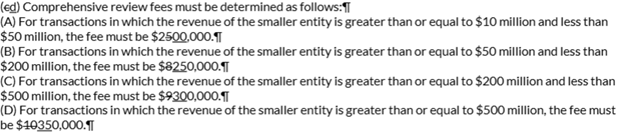
- Significantly increased HCMO review fees. The preliminary review fee increases from $2,000 to $30,000, while comprehensive review fees increase from $25,000–$100,000 to $200,000–$350,000, depending on the applicable entity’s revenue.
- New post-approval transaction deadlines. Approved transactions must now become effective within 60 calendar days after OHA issues its final approval order, and parties must notify OHA within seven business days if an approved transaction fails or is abandoned.
- New civil penalty schedule. The amended rules establish penalties of up to $10,000 per offense against entities that commit specified HCMO violations, including failing to submit a transaction subject to review and failing to comply with conditions imposed on an approved transaction.
Amended Rules Significantly Expand Which Entities May Qualify as Out-of-State
The amended rules significantly broaden the circumstances in which an entity domiciled outside Oregon may be considered an “out-of-state entity” for purposes of HCMO review. Under the amended framework, an entity domiciled outside Oregon that otherwise satisfies any of the criteria for being considered in-state, including because it: (i) owns or operates a location in Oregon; (ii) is registered to do business in Oregon; (iii) engages in activity for the purpose of realizing gain or profit in Oregon; or (iv) delivers, furnishes, or otherwise provides healthcare services to Oregon residents,2 may nevertheless be considered an “out-of-state entity” if it provided healthcare items or services to no more than 100 Oregon residents annually in each of the three preceding fiscal years.3 Previously, this pathway to out-of-state treatment did not expressly extend to entities with other types of Oregon nexus, such as operating a location in the state or providing healthcare services to Oregon residents.
This change may be particularly significant for digital health and other national healthcare companies, which often operate across state lines and may have a limited Oregon footprint despite technically satisfying one or more of the criteria for being considered an in-state entity. Parties to transactions involving such companies should carefully assess the number of Oregon residents served during the applicable three-year lookback period rather than assuming that an entity’s registration, business activities, or provision of services in Oregon makes it an in-state entity for purposes of HCMO review.
Importantly, classification as an “out-of-state entity” does not necessarily place a transaction outside the scope of HCMO review. The rules still expressly provide that a covered transaction that otherwise satisfies the applicable financial materiality thresholds “must be subject to review under these rules notwithstanding that the transaction involves a health care entity in this state and an out-of-state entity if the transaction may increase the price of health care services or limit access to healthcare services in this state.”4
Qualifying as an out-of-state entity should not be viewed as an automatic exemption from HCMO review, and parties should separately assess whether the transaction may affect healthcare prices or access in Oregon.
Amended Rules Narrow the Exclusion for Certain Internal Reorganizations
Previously, a transaction consisting solely of a change in the immediate or intermediate ownership of a healthcare entity was excluded from HCMO review if it: (i) did not change the ultimate ownership or control of the healthcare entity; and (ii) did not result in the acquisition of control by a person not previously affiliated with the healthcare entity.
Under the amended rules, a third requirement now applies to further narrow this exception: the transaction must not “involve an agreement between the health care entity and another person that otherwise constitutes a covered transaction and is not excluded from review” under the specified exclusions.5
This new limitation is important for multi-step restructurings and transactions involving related agreements. Even where an internal reorganization leaves ultimate ownership and control unchanged and does not introduce a new unaffiliated controlling person, the exclusion will not apply if the broader arrangement includes a separate agreement that independently constitutes a non-excluded covered transaction. Parties should therefore evaluate the full set of related agreements and transaction steps before relying on the internal reorganization exclusion.
New Civil Penalties Apply to HCMO Violations
Previously, Oregon law authorized OHA to impose civil penalties for violations of the HCMO requirements,6 but the HCMO regulations did not establish a specific schedule identifying the penalties applicable to particular violations. The amended rules now add a civil penalty rule that expressly identifies the conduct subject to penalties and establishes penalties against entities that commit specified violations.7
Under the new rule, OHA may impose a civil penalty of up to $10,000 per offense on an entity that fails to submit a material change transaction that is subject to HCMO review. The same maximum penalty applies to an entity’s failure to timely respond to OHA’s clarifying questions or information requests, provide requested documentation, or comply with a condition specified in an OHA order.8 The rule further provides that “[e]very violation of an order, rule or regulation is a separate offense subject to a separate civil penalty,” although OHA may consider an entity’s documented efforts to comply with the rules as a mitigating factor before imposing penalties.9
The new rule also incorporates OHA’s existing statutory enforcement authority into the HCMO regulations and provides that the director of OHA may seek a court order enjoining a person, and any director, officer, employee, or agent of that person, from continuing a violation, as well as other equitable relief warranted by the circumstances and the public interest.10 Thus, while the amended rules provide new specificity regarding the civil penalties applicable to HCMO violations, they also consolidate OHA’s broader existing statutory enforcement authority within the HCMO regulatory framework.
The new penalty schedule provides greater clarity regarding the consequences of HCMO noncompliance and creates a significant financial risk for entities that fail to identify a required filing or satisfy ongoing regulatory obligations. The amendments also expressly tie the existing requirements applicable to conditionally approved transactions to the new penalty schedule: if an entity fails to comply with an approval condition and does not come into compliance within 30 calendar days after written notification, penalties may be assessed.11 Accordingly, parties should consider not only their initial filing obligations, but also ongoing compliance with OHA information requests and any conditions imposed as part of the approval process.
New Rules Establish Additional Transaction and Post-Approval Procedures
The amended rules impose, for the first time, a deadline for consummating an approved material change transaction: an approved transaction must now become effective no later than 60 calendar days after OHA issues its final approval order.12 This new requirement is particularly significant for transaction planning because parties will need to coordinate the HCMO review process with other closing conditions, including other regulatory approvals, financing requirements, and third-party consents, to ensure that the transaction can close within the 60-day window.
The amended rules also add a new notification requirement for situations where an approved transaction does not proceed: a party must notify OHA in writing within seven business days if the transaction fails or is abandoned.13 In addition, the rules continue to require a healthcare entity that is a party to an approved transaction to notify OHA in writing no more than one business day after completion.
Finally, the amended rules accelerate one aspect of the existing emergency-exemption process. The substantive standard for obtaining an emergency exemption remains unchanged, but OHA must now provide an applicant with three business days’ advance notice before posting an emergency-exemption application for public comment, rather than the 10 calendar days previously required.14 For transactions facing genuine exigent circumstances, the shorter notice period may help reduce delay in the emergency exemption process, although the underlying standard for obtaining an exemption remains unchanged.
Transaction Review Fees Increase Significantly
Beginning July 1, 2026, parties submitting transactions for HCMO review will face substantially higher filing and review fees. Most notably, the fee for a preliminary review increases from $2,000 to $30,000, a 15-fold increase. Transactions that proceed to comprehensive review will be subject to fees ranging from $200,000 to $350,000, compared to the prior $10,000 to $100,000 range, representing increases of up to $250,000 depending on the applicable entity’s revenue. The fee for an emergency exemption request remains $2,000.15
For parties contemplating transactions that may be subject to HCMO review, these increases make the filing analysis a potentially significant deal-cost issue, not simply a timing consideration. Parties should assess HCMO applicability early in the transaction process and consider expressly allocating responsibility for HCMO filing and review costs in the transaction documents. The potential cost of a comprehensive review also makes it increasingly important to identify and resolve threshold questions regarding whether a transaction is subject to HCMO review before a notice is submitted.
The increased fees may be particularly significant because the parties are also responsible for reimbursing OHA for reasonable and actual costs incurred in reviewing the transaction, including the costs of outside advisors retained by OHA. Those reimbursement obligations apply regardless of whether OHA ultimately approves the transaction.16 Accordingly, for transactions that proceed to comprehensive review, the total regulatory cost may materially exceed the applicable review fee itself.
Key Takeaways
The amended rules provide important new guidance regarding the scope of Oregon’s HCMO program while also increasing the potential financial and enforcement consequences for transactions that are subject to review. For national and multistate healthcare companies in particular, the expanded circumstances in which an entity domiciled outside Oregon may qualify as an “out-of-state entity” may materially affect whether a transaction falls within the HCMO framework.
Transaction parties should evaluate the Oregon nexus of each potentially relevant entity early in diligence, determine whether an entity may qualify for out-of-state treatment under the expanded framework, and account for the potential timing, cost, and post-closing requirements associated with OHA review.
To better understand how these amendments may affect your business or for assistance in addressing these changes, please contact Wilson Sonsini attorneys Andrea Linna, Nawa Lodin, Seamus Taylor, or any member of Wilson Sonsini’s Healthcare and FDA Regulatory practice.
[1] https://www.propublica.org/article/oregon-healthcare-mergers-oversight-law
[2] Or. Admin. R. 409-070-0015(2)(a).
[3] Or. Admin. R. 409-070-0015(2)(a)-(b).
[4] Or. Admin. R. 409-070-0015(2)(b)(B).
[5] Or. Admin. R. 409-070-0020(1)(f)(C).
[7] Or. Admin. R. 409-070-0067.
[8] Or. Admin. R. 409-070-0067(1)(a)-(d).
[9] Or. Admin. R. 409-070-0067(2)-(3).
[10] Or. Admin. R. 409-070-0067(6); Or. Rev. Stat. § 415.501(22).
[11] Or. Admin. R. 409-070-0065(3).
[12] Or. Admin. R. 409-070-0045(12).
[13] Or. Admin. R. 409-070-0045(13).
[14] Or. Admin. R. 409-070-0022(4)(b).
[15] Or. Admin. R. 409-070-0030.
[16] Or. Admin. R. 409-070-0050.
[17] Screenshot of the state’s redline changes to the fee schedule.