
WSGR logoWSGR logo
WSGR logo
  • Experience
  • People
  • Insights
  • About Us
  • Careers

  • Practice Areas
  • Industries

  • Corporate
  • Intellectual Property
  • Litigation
  • Patents and Innovations
  • Regulatory
  • Technology Transactions

  • Capital Markets
  • Corporate Governance
  • Corporate Life Sciences
  • Derivatives
  • Emerging Companies and Venture Capital
  • Employee Benefits and Compensation
  • Energy and Climate Solutions
  • Executive Advisory Program
  • Finance and Structured Finance
  • Fund Formation
  • Greater China
  • Mergers & Acquisitions
  • Private Equity
  • Public Company Representation
  • Real Estate
  • Restructuring
  • Shareholder Engagement and Activism
  • Tax
  • U.S. Expansion
  • Wealthtech

  • Special Purpose Acquisition Companies (SPACs)

  • Environmental, Social, and Governance

  • AI and Data Center Infrastructure
  • Energy Regulation and Competition
  • Project Development and M&A
  • Project Finance and Tax Credit Transactions
  • Sustainability and Decarbonization
  • Transportation Electrification

  • U.S. Expansion Library and Resources

  • Post-Grant Review
  • Trademark and Advertising

  • Antitrust Litigation
  • Arbitration
  • Board and Internal Investigations
  • Class Action Litigation
  • Commercial Litigation
  • Consumer Litigation
  • Corporate Governance Litigation
  • Employment Litigation
  • Executive Branch Updates
  • Government Investigations
  • Internet Strategy and Litigation
  • Patent Litigation
  • Securities Litigation
  • State Attorneys General
  • Supreme Court and Appellate Practice
  • Trade Secret Litigation
  • Trademark and Copyright Litigation
  • Trial
  • White Collar Crime

  • Advertising, Promotions, and Marketing
  • Antitrust and Competition
  • Committee on Foreign Investment in the U.S. (CFIUS)
  • Communications
  • Data, Privacy, and Cybersecurity
  • Export Control and Sanctions
  • FCPA and Anti-Corruption
  • FDA Regulatory, Healthcare, and Consumer Products
  • Federal Trade Commission
  • Fintech and Financial Services
  • Government Contracts
  • National Security and Trade
  • Payments
  • State Attorneys General
  • Strategic Risk and Crisis Management
  • Tariffs, Customs, and Import Compliance

  • Antitrust and Intellectual Property
  • Antitrust Civil Enforcement
  • Antitrust Compliance and Business Strategy
  • Antitrust Criminal Enforcement
  • Antitrust Litigation
  • Antitrust Merger Clearance
  • European Competition Law
  • Third-Party Merger and Non-Merger Antitrust Representation

  • Anti-Money Laundering
  • Foreign Ownership, Control, or Influence (FOCI)
  • Team Telecom

  • AI in Healthcare
  • Animal Health
  • Artificial Intelligence and Machine Learning
  • Aviation
  • Biotech
  • Blockchain and Cryptocurrency
  • Clean Energy
  • Climate and Clean Technologies
  • Communications and Networking
  • Consumer Products and Services
  • Data Storage and Cloud
  • Defense Tech
  • Diagnostics, Life Science Tools, and Deep Tech
  • Digital Health
  • Digital Media and Entertainment
  • Electronic Gaming
  • Fintech and Financial Services
  • FoodTech and AgTech
  • Global Generics
  • Internet
  • Life Sciences
  • Medical Devices
  • Mobile Devices
  • Mobility
  • NewSpace
  • Quantum Computing
  • Semiconductors
  • Software

  • Offices
  • Country Desks
  • Events
  • Pro Bono
  • Community
  • Our Diversity
  • Sustainability
  • Our Values
  • Board of Directors
  • Management Team

  • Austin
  • Boston
  • Boulder
  • Brussels
  • Century City
  • Hong Kong
  • London
  • Los Angeles
  • New York
  • Palo Alto
  • Salt Lake City
  • San Diego
  • San Francisco
  • Seattle
  • Shanghai
  • Washington, D.C.
  • Wilmington, DE

  • Law Students
  • Judicial Clerks
  • Experienced Attorneys
  • Patent Agents
  • Business Professionals
  • Alternative Legal Careers
  • Contact Recruiting
EU AI Act to Enter into Force in August
Alerts
July 12, 2024

On July 12, 2024, the European Union’s (EU) Artificial Intelligence Act (AI Act) was published in the Official Journal of the EU. This was the last step for the AI Act to become law. The AI Act will enter into force 20 days after the publication, i.e., on August 1.

Will the EU AI Act Start to Apply Right Away?

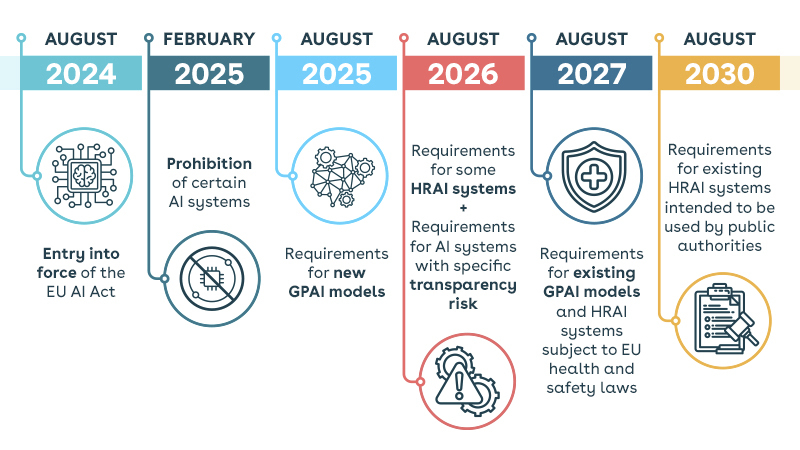
The AI Act will not start to apply right after it has entered into force. Rather, the new rules will start to apply in phases:

  • Prohibitions of certain AI systems: The first set of rules to kick in will be those prohibiting certain applications of AI (e.g., AI systems that exploit individuals’ vulnerabilities, untargeted scraping of facial images from the internet or CCTV footage to create facial recognition databases). These rules will start to apply as of February 2025.
  • General-purpose AI (GPAI) models: The requirements in relation to new GPAI models will start to apply one year after the entry into force of the AI Act, i.e., by August 2025. There will be an additional two-year grace period for GPAI models that are already on the EU market at that time (i.e., providers of GPAI models placed on the EU market before August 2025 will have an additional two years to comply, until August 2027).
  • High-risk AI (HRAI) systems: The rules for some HRAI systems and AI systems with specific transparency risk will start to apply by August 2026. If the HRAI system is part of a product that is subject to EU health and safety laws (e.g., toys) the rules will apply a year later (i.e., by August 2027). Operators of HRAI systems that are already offered in the EU before the application of the AI Act will need to comply with the AI Act only in the event of a significant design change (e.g., changes in the AI system’s intended purpose). As an exception to this, if the HRAI system offered in the EU is intended to be used by public authorities, the providers and deployers will need to comply with the rules by August 2030, regardless of whether there has been a significant design change or not.

EU AI Act Timeline
Once the AI Act starts to apply, it will introduce a swathe of new obligations for companies providing, distributing, importing, and using AI systems and GPAI models in the EU, subject to hefty fines of up to EUR 35 million or seven percent of the total worldwide annual turnover, whichever is higher.

For more information about the scope and requirements in the AI Act, please see our FAQ on 10 Things You Should Know About the EU AI Act.

If you have any questions regarding the AI Act, please contact Laura De Boel, Cédric Burton, Yann Padova, or Nikolaos Theodorakis from Wilson Sonsini’s privacy and cybersecurity practice.

Wilson Sonsini’s AI Working Group assists clients with AI-related matters. Please contact Laura De Boel, Maneesha Mithal, Manja Sachet, or Scott McKinney for more information.

Rossana Fol, Roberto Yunquera Sehwani, and Karol Piwonski contributed to the preparation of this client alert.

Contributors

  • Laura De Boel
  • Rossana Fol
  • Roberto Yunquera Sehwani
  • Karol Piwonski
  • people
  • insights
  • about us
  • careers
  • Binder
  • Alumni
  • Mailing List Signup
  • Client FTP Portal
  • Privacy Policy
  • Terms of Use
  • Accessibility
WSGR logo
Twitter
LinkedIn
Facebook
Instagram
Youtube
Copyright © 2026 Wilson Sonsini Goodrich & Rosati. All Rights Reserved.