Effective May 15, 2020,1 the U.S. Department of Commerce's Bureau of Industry and Security (BIS) issued an interim final rule that further tightens export controls on Huawei Technologies Co. Ltd. of China and its 100-plus affiliates that are also listed on BIS's Entity List with a footnote 1 designation (collectively, "FN1E"). The new rule expands the Export Administration Regulations' (EAR's) "foreign direct product rule" (FDPR) by broadening the scope of foreign-produced technologies, software, and commodities (collectively, "items") that require a BIS authorization before being provided to a designated FN1E.
Under the new rule, foreign-produced items that are developed or produced by a plant that has a major component which was produced using technology or software classified under one of 16 specified EAR-controlled U.S. technologies/software may require BIS authorization before being sent to an FN1E. Similarly, foreign-produced items that are developed or produced from any of the specified U.S. technologies or software are also subject to the EAR and may require BIS authorization before being sent to an FN1E. The rule does not impact the sale of foreign-produced, commercial off-the-shelf items. Further, Huawei-produced items destined for third parties that are not included on the Entity List or other applicable sanctioned persons list are outside the scope of the new rule. We expect the rule to have the most significant impact on foreign developers who work with Huawei on the design and development of items and on foreign manufacturers who use certain U.S.-origin technology, software, or equipment to produce items for Huawei.
Background
In May and August 2019, Huawei and over 100 of its affiliates, including HiSilicon, were added to BIS's Entity List. As a result, a license from BIS is required for any export, reexport, or in-country transfer of any item subject to the EAR, directly or indirectly, to these Huawei entities. Items subject to the EAR include: (1) items exported from the United States (even if foreign-origin items); (2) U.S.-origin items, irrespective of current location; (3) items that are the foreign direct product of certain U.S.-origin technology or software (the FDPR); and/or (4) foreign-origin items that incorporate more than a de minimis amount of controlled U.S.-origin parts, materials, and/or components (known as the De Minimis Rule). The new rule broadens the scope of items subject to the EAR, specifically the FDPR.
The Expanded Foreign Direct Product Rule
Previously, the FDPR included items based on certain highly controlled software and technology. The new rule expands the scope of this rule to include items based on or created with certain low-level technologies and software, including ones controlled only for anti-terrorism reasons. There are two parts to the new rule: i) foreign-produced direct products of specified U.S. technologies and software, and ii) foreign products that are the direct product of a plant or major component of a plant.
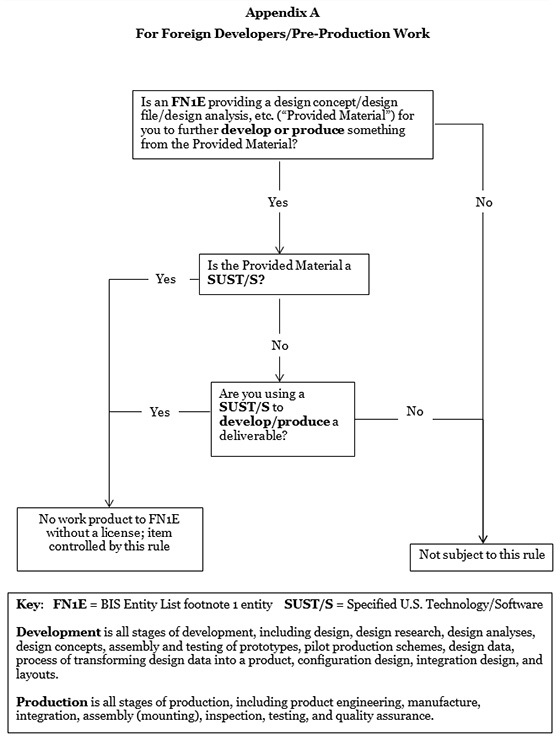
- Foreign-Produced Direct Products of Specified U.S. Technologies and Software: Controls on certain foreign-produced items based on U.S.-origin software or technology listed in one of 16 specified export control classification numbers (ECCNs), referred to as specified U.S. technology and software (or SUST/S). The SUST/S capture a wide range of U.S.-origin semiconductor, computing, and telecommunications technologies and software.2 To be subject to the license requirement, an FN1E must have either designed or produced the item (i.e., provided a design concept/design file/design analysis, etc.) and a SUST/S must be involved. Foreign entities that work with Huawei to design or produce an item for Huawei are likely to be most impacted by this license requirement. A flow chart outlining the analysis for foreign developers is included below as Appendix A.
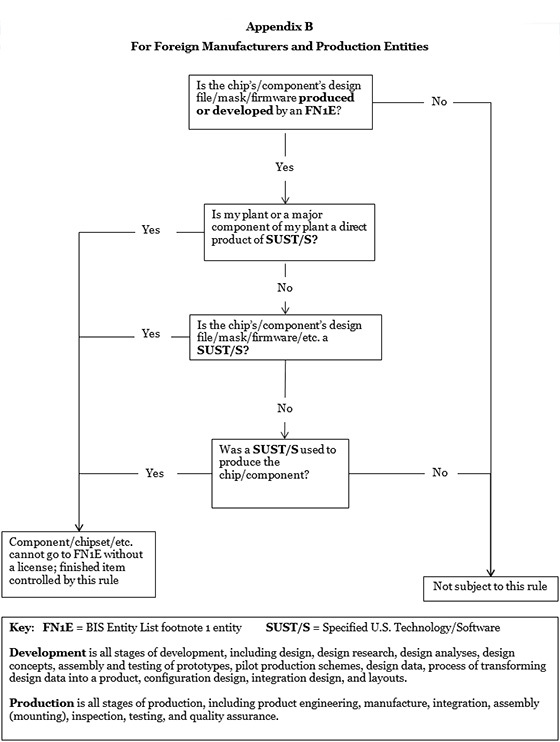
- Direct Product of a Plant or Major Component of a Plant: Controls on foreign-produced items developed or produced by Huawei, irrespective of the origin of the technology or software, that are produced using either i) U.S.-origin equipment classified under one of the 16 SUST/S, or ii) foreign-produced equipment that is the direct product of one of the 16 SUST/S. Thus, a foreign manufacturer utilizing U.S.-origin equipment classified under ECCN 3B991 that is producing a chipset for Huawei will likely need to obtain a BIS license prior to exporting or transferring the chipset to Huawei. A flow chart to help foreign manufacturers navigate the rule is included below as Appendix B.
Conclusion
While the analysis of whether this rule applies is complex, it is important to recognize that the new rule only covers foreign-produced items designed or developed by or for Huawei, or another FN1E. Further, the rule is limited to exports, reexports, and transfers back to the FN1E, and it does not subject foreign-produced, Huawei-designed or produced items destined for third parties not listed on BIS's Entity List to the new license requirement. Exports of virtually any item from the United States destined for an FN1E, such as Huawei, already required a BIS license prior to this rule.
For questions regarding the FDPR or export controls more generally, please contact a member of Wilson Sonsini's export controls practice, which includes Josephine Aiello LeBeau and Anne Seymour.
[1] While the new FDPR was effective May 15, BIS is accepting public comments regarding the new rule through July 14, 2020.
[2] The ECCNS are 3D001, 3D991, 3E001, 3E002, 3E003, 3E991, 4D001, 4D993, 4D994, 4E001, 4E992, 4E993, 5D001, 5E001, 5D991, and 5E991.