
Summary
On December 22, 2023, the U.S. Department of the Treasury (Treasury) and the Internal Revenue Service (IRS) issued a notice of proposed rulemaking (the Proposed Regulations) regarding the Clean Hydrogen Production credit under Section 45V of the Internal Revenue Code of 1986, as amended (the Code), pursuant to changes authorized by the Inflation Reduction Act of 2022 (IRA). Wilson Sonsini is providing this brief summary of the Proposed Regulations and will issue further, in-depth analysis later this month.
The Proposed Regulations provide draft rules regarding the production and sale of clean hydrogen, and in particular on the Greenhouse gases, Regulated Emissions, and Energy use in Technologies Model (GREET Model) used to define lifecycle greenhouse gas emissions and the utilization of Energy Attribute Certificates (EACs) or Renewable Energy Certificates (RECs, and together with EACs referred to jointly as EACs) for hydrogen produced using grid-connected electricity. The proposed rules regarding hydrogen produced with grid-connected electricity adopt the “three pillars” approach, requiring hydrogen producers utilizing grid-connected power to demonstrate that their clean power source was “new” or “incremental,” that the power is “deliverable,” or sourced from the same region as the taxpayer, and that the new, deliverable clean power is generated in the same year as the clean hydrogen produced, with a phase-in to hourly or time-matching generation as evidenced by EACs.
Section 45V provides a 10-year production tax credit or investment tax credit for taxpayers who produce qualifying clean hydrogen at a facility placed into service after December 31, 2022, which began construction before January 1, 2033, with four technology-neutral credit tiers or amounts. These four tiers are determined based upon the lifecycle greenhouse gas emissions rate (LCA) as determined by the GREET Model resulting from production as follows:
|
Kg of CO2e/kg of qualifying clean hydrogen produced |
Production Tax Credit Rate - $0.60/kg (as adjusted for inflation) of hydrogen multiplied by: |
Investment Tax Credit Rate - % of the cost of the facility or modification: |
|
2.5 to 4 |
20% |
1.2% |
|
1.5 to < 2.5 |
25% |
1.5% |
|
0.45 to < 1.5 |
33.4% |
2% |
|
< 0.45 |
100% |
6% |
The base credits above are multiplied by five if either the construction of the facility begins prior to January 29, 2023, and any alteration or repair of the facility that occurs after such date meets the prevailing wage and apprenticeship requirements, or if the prevailing wage and apprenticeship requirements are met with respect to both construction and alteration and repair. Please see here for further Wilson Sonsini information regarding prevailing wage and apprenticeship requirements.
Taxpayers receiving 45V can claim the Section 48 investment tax credit (ITC) or Section 45 production tax credits (PTC) on qualifying renewable energy and emissions-free nuclear energy properties used to generate electricity to power the production of the hydrogen facility, including bonus credits thereto. However, taxpayers claiming tax credits for qualifying carbon capture and sequestration under Section 45Q or clean fuel production under Section 45Z cannot stack these credits (for which they would otherwise be eligible) for the production of qualifying clean hydrogen from that same facility.
45V is eligible for both transferability and direct pay for a period of five years. For more on transferability and direct pay, please see the Wilson Sonsini white paper on monetizing credits under these options.
Effective Date
The Proposed Regulations are intended to apply to taxable years beginning after they are published in the Federal Register. Taxpayers may rely on these Proposed Regulations for taxable years beginning after December 31, 2022, and before the date that the final regulations are published, provided that taxpayers follow the Proposed Regulations in their entirety and in a consistent manner.
Key Takeaways
- Hydrogen Produced Using Grid Energy: The Proposed Regulations state that taxpayers may use EACs to demonstrate the purchase of clean power for hydrogen produced using grid-connected power for the purposes of determining the applicable credit tier (see table above). EACs must adhere to three principal criteria set forth below. As rationale for this proposed requirement, the Background to the Proposed Regulations states that “[i]f hydrogen producers rely on EACs without attributes that meet these three criteria there is a significant risk that hydrogen production would significantly increase induced grid GHG emissions beyond the allowable levels required to qualify for the section 45V credit.”
- Additionality or Incrementality: EACs must be sourced from clean power generation that began commercial operations within three years of the taxpayer’s hydrogen facility being placed into service. Generation resulting from newly added capacity to facilities older than three years can also be included.
- Deliverability: Clean power must be sourced from the same region as the taxpayer—i.e., the clean power source and the hydrogen production facility must be electrically interconnected to balancing authorities in the same region. The applicable regions are defined pursuant to the Department of Energy’s 2003 National Transmission Needs Study, but the relevant map is located in the Guidelines to Determine Well-to-Gate Greenhouse Gas (GHG) Emissions of Hydrogen Production Pathways using 45VH2-GREET 2023 (GREET User Manual). Those regions are:
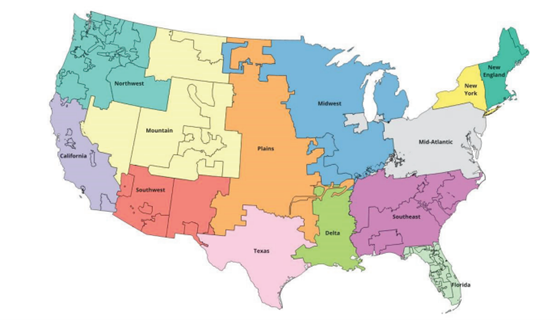
Note that while Alaska and Hawaii are not depicted, they are treated as two additional regions, one covering the entirety of Hawaii and the other the entirety of Alaska. Similarly, each U.S. Territory is considered a separate region.
Source: GREET User Manual
- See GREET User Manual here.
- Time-Matching: Time-matching has a two-phase or transition formula designed to meet industry tracking system expectations. For projects producing hydrogen before January 1, 2028, the Proposed Rules provide for annual matching of EACs on a calendar-year basis, shifting to hourly matching after the transition period. The Federal Register indicates the expectation, based on a survey of nine existing systems, that tracking systems should be able to meet hourly time-stamped EAC offerings by 2028, but specifically acknowledged uncertainty in the transition timing and requested additional comment on the transition timeline.
- GREET Model White Paper: The IRA requires that the LCA must be established utilizing the GREET Model. As part of the Proposed Regulations, the Department of Energy released a technical white paper describing how the GREET Model will be implemented for these purposes. The GREET Model is currently used in other contexts, such as to determine the LCA for qualifying projects receiving Low Carbon Fuel Standard (LCFS) credits in California.
- See GREET Model White Paper here.
- EPA Letter: The Proposed Regulations are also accompanied by a letter from the Environmental Protection Agency (EPA) on the definition of LCA under the Clean Air Act to support the Proposed Regulations interpretation.
- See EPA letter here.
Key Wilson Sonsini Observations
- Market Transformation on EACs to Meet Hourly Time-Matching Demand: The hourly time-matching requirements for the use of EACs, which go into effect in 2028, will require substantial market transformation of current offerings among voluntary tracking systems around the United States. According to an analysis prepared by the Center for Resource Solutions, the majority of existing U.S. EAC tracking systems estimate “a short phase-in period of 1-2 years once the decision to implement hourly tracking has been made.” However, Western Renewable Energy Generation Information Systems (WREGIS), the tracking system covering California and other western states, provided the longest estimate of three-to-five years, according to the same report. Currently, only three U.S. tracking systems currently have hourly time-matched offerings: M-RETS, NAR, and PJM-GATS, all of which have either limited functionality or are in pilot phases, according to the same Center for Resource Solutions report. Current U.S. tracking systems include:
- ERCOT
- MIRECS
- M-RETS
- NAR
- NC-RETS
- NEPOOL-GIS
- NVTREC
- NYGATS
- PJM-GATS
- WREGIS
- Additionality and Retiring Nuclear Fleet: Notably, the Proposed Regulations require “additionality” such that EACs from new clean power must be from generation that began commercial operations within three years from the date that the taxpayer elects 45V. At the same time, 45V is technology neutral. This would appear to limit the utilization of nuclear facilities in the short term, as virtually none will meet that threshold for the current, utility-scale fleet. However, the guidance acknowledges this, and requests comments on the extent to which Treasury and IRS should allow existing “minimal-emitting generators” who wish to provide EACs to hydrogen producers to demonstrate incrementality “through submission to the IRS or another Federal agency, such as DOE, [of] specific information that supports a conclusion the electricity generator is at risk of retirement that may be mitigated by sales to hydrogen producers.”
- Harmonization with EU Regulations: The EU has adopted the “three pillars” in its clean hydrogen regulations, and has further established that the EU will not import hydrogen or any products derived from hydrogen (e.g., fertilizer, steel, sustainable aviation fuel) if EU standards are not met. The Proposed Regulations mirror the EU regulations in these key ways, setting up U.S. hydrogen producers to be able to access European markets.
Request for Public Comments
Treasury and the IRS request comments on all aspects of the Proposed Regulations within 60 days of the date of publication in the Federal Register, in particular the following:
- The approaches by which generation from existing clean power generators could be considered to meet the requirements for additionality
- How to consider transmission of clean power between regions derived from the DOE 2023 National Transmission Needs Study
- Various areas of feedback regarding hourly time-matched EACs
A hearing on the Proposed Regulations is scheduled for March 25, 2024, at 10:00 a.m. Eastern. Requests to speak and outlines of topics must be received by March 4, 2024. Requests to attend the public hearing must be received by March 18, 2024.
Our team would be pleased to assist you in your strategic planning or preparation of comments. For more information on issues pertaining to tax and energy and climate solutions, please contact Wilson Sonsini attorneys Nicole Gambino, Jaron Goddard, Brandon King, Peter Mostow, Scott Zimmermann, and Elise Zoli.